21 March 2015

Waiting patiently for Philae


Perhaps it is still too cold for the Philae lander to wake up on Comet 67P/Churyumov-Gerasimenko. Maybe its power resources are not yet sufficient to send a signal to the team at the German Aerospace Center (Deutsches
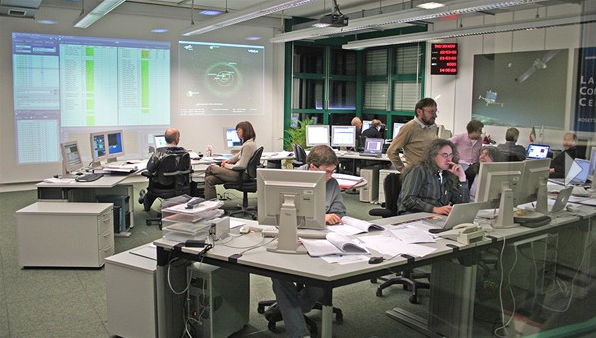
View of the Lander Control Center at
DLR Cologne, Copyright: DLR Cologne
Zentrum für Luft- und Raumfahrt; DLR) Lander Control Center. On 12 March 2015, the Rosetta orbiter began to send signals to the lander and listen for a response, but Philae has not yet reported back. "It was a very early attempt; we will repeat this process until we receive a response from Philae," says DLR Project Manager Stephan Ulamec. "We have to be patient." On 20 March 2015 at 05:00 CET, the communication unit on the Rosetta orbiter was switched off. Now, the DLR team is calculating when the next favourable alignment between the orbiter and the lander will occur, and will then listen again for a signal from Philae. The next chance to receive a signal from the lander is expected to occur during the first half of April.
After it landed on Comet 67P/Churyumov-Gerasimenko on 12 November 2014, Philae operated continuously for 54 hours; all 10 instruments were used and sent data back to Earth. Then, the lander’s battery was exhausted and Philae went into hibernation at its rather shadowed location. Now, it needs an internal temperature above minus 45 degrees Celsius and at least five watts of power to automatically turn on. Until it can generate a total of 19 watts, it cannot send signals to Earth via the orbiter. For the months of January and February, the engineers at DLR could definitely rule out the ending of hibernation: "Our simulations clearly showed that Philae would still be too cold to reawaken," says Koen Geurts, a member of the control room team at DLR. The engineers saw a first, albeit early, chance in March, when the comet and the lander would be about 300 million kilometres from the Sun – and the amount of solar radiation had nearly doubled when compared to the previous November.
Favourable conditions and new commands
The lander team at DLR is planning the next attempt to communicate with Philae in April. For this, the orbiter must be in a suitable orbital configuration and range with respect to the lander to allow contact. In addition, Philae must be exposed to sunlight and be generating sufficient power to listen for the signal from the orbiter and be able to respond. “These conditions must last for at least 45 minutes, because Philae only operates its receiver every 30 minutes after awakening," explains Geurts.
Waking might be more likely in April, because the team at the Lander Control Center has sent new command sequences to Philae six times, with the primary purpose of instructing the lander to most effectively divide the available solar power between heating and communications. The last time the lander was instructed was on 17 March 2015 at 12:30 UTC, using 'blind commanding' to optimise its energy usage. "We are sure that the communication unit on the orbiter worked, but whether Philae has received the new commands, we do not yet know," says Geurts. It could be that the lander is already awake but does not yet have enough power to transmit a response; in this case, Philae could still receive the commands and execute them.
By the summer, when the comet is much closer to the Sun, the team is hoping to see signs of life from the lander and to receive data regarding the condition of Philae. What is the internal temperature of the lander? Are all its systems working correctly or has the hibernation at very low temperatures had unwanted consequences? How much solar radiation, and thus power, is it receiving? Is the battery charging? After the data is carefully evaluated to determine the 'health' of Philae, the plan is to begin using its instruments and shift work in the DLR Lander Control Center will resume. Once the lander is awake, it will carry out its tasks – Geurts is certain: "Philae is in an optimal location for surviving on the comet."

Contacts:

Manuela Braun 
German Aerospace Center (DLR) 
Corporate Communications
Editor, Human Space Flight, 
Space Science, Engineering 
Tel.: +49 2203 601-3882 
Fax: +49 2203 601-3249 
mailto:Manuela.Braun@dlr.de 

Dr Stephan Ulamec 
German Aerospace Center (DLR) 
Microgravity User Support Center (MUSC)
Space Operations and Astronaut Training 
Tel.: +49 2203 601-4567 
mailto:Stephan.Ulamec@dlr.de 

Dr Koen Geurts 
German Aerospace Center (DLR) 
Space Operations and Astronaut Training 
Tel.: +49 2203 601-3636 
mailto:Koen.Geurts@DLR.de 

10 March 2015

VII. Swiss International Summer University on Renewables, ISUenergy 2015


The ISUenergy organizing committee is designing the already 7th International Summer University on Renewable Energies, the ISUenergy 2015.
This summer university is an internationally established event since 2009.

The ISU
energy2015 will take place from Aug. 23rd - Sept. 4th 2015 in Falera/Switzerland.
Excellent Master, Diploma, and PhD students from all over the world from different disciplines are invited to participate in this two-week event.
The interdisciplinary summer university focuses among other topics on
  • Photovoltaics
  • Solar architecture/BIPV
  • Electro-mobility
  • Solar thermal aspects
  • Smart grids
  • Economic and political aspects.
These topics will be treated in lectures, evening talks, practical workshops, and group projects.

The ISU
energy2015 provides a unique setting for students to enrich their knowledge on energy topics. Splendid network opportunities among the students and with the lecturers will be offered.
You can find more information on ISU
energy 2015 costs, accommodation etc. under http://www.helmholtz-berlin.de/events/isu-energy/

Applications are invited from March 1st until July 5th, 2015. Simply follow the link http://www.helmholtz-berlin.de/events/isu-energy/applications/ to submit your applications.Early bird fee applications will be valid before May 15th, 2015, only.

Please feel free to advertise the ISU
energy 2015 by posting it and by forwarding this mail to any parties that might be interested in participating in the ISUenergy 2015.
Thank you.

If you should have any questions, you are always welcome to contact us for more information: isue@helmholtz-berlin.de
 .

Best regards,
ISU
energy 2015 Team


Helmholtz-Zentrum Berlin für Materialien und Energie GmbH
Mitglied der Hermann von Helmholtz-Gemeinschaft Deutscher Forschungszentren e.V.
Aufsichtsrat: Vorsitzender Prof. Dr. Dr. h.c. mult. Joachim Treusch, stv. Vorsitzende Dr. Beatrix Vierkorn-Rudolph
Geschäftsführung: Prof. Dr. Anke Rita Kaysser-Pyzalla, Thomas Frederking

Sitz Berlin, AG Charlottenburg, 89 HRB 5583

Postadresse:
Hahn-Meitner-Platz 1
D-14109 Berlin

http://www.helmholtz-berlin.de

07 March 2015

A new tool for detecting and destroying norovirus

Electron micrograph of norovirus virus-like particles (VLPs) and a cartoon representation of a nanobody, termed Nano-85 (orange). Nano-85 binds to the VLPs and causes the VLPs to disassemble.
Source: Dr. Grant Hansman, DKFZ
Norovirus infection is the most common cause of viral gastroenteritis, or "stomach flu." A research team at the German Cancer Research Center (DKFZ) recently produced "nanobodies" that could be used to better characterize the structural makeup of the virus. They discovered that these nanobodies could detect the virus in clinical stool samples and disassemble intact norovirus particles. Such nanobodies may potentially be used to not only better detect but also treat symptoms of norovirus infection in the clinic.

Infection with highly contagious noroviruses, while not usually fatal, can lead to a slew of unpleasant symptoms such as excessive vomiting and diarrhea. Current treatment options are limited to rehydration of the patient. "Additionally, noroviruses come in a variety of constantly evolving strains. This makes the development of an effective vaccine to protect against infection, as well as antiviral therapy to combat already-existing infections, particularly challenging", says Dr. Grant Hansman, a virologist who leads the CHS Research Group on Noroviruses at the German Cancer Research Center (Deutsches Krebsforschungszentrum, DKFZ) and Heidelberg University.

Hansman's research team recently discovered that a "nanobody" called Nano-85 was able to bind to intact norovirus-like particles (VLPs) in culture. Nanobodies are very similar to antibodies, which recognize and bind to antigens. "However, nanobodies are much smaller, more stable, easier to produce, and cost-effective than traditional monoclonal antibodies," says Hansman. Interestingly, Nano-85 was able to recognize the VLPs from a variety of different norovirus strains.

The researchers then tested the nanobody on stool samples from patients infected with the virus. In this context, Nano-85 was able to detect virus in one-third of the samples already known to be positive for noroviral RNA. "Because noroviruses are changing all the time, there is a need for more powerful tools to detect emerging noroviruses. We still need to optimize detection using Nano-85, but we hope that it could potentially be used as a diagnostic tool further on down the road," explains Hansman.

In solution, Nano-85 was also able to bind to a specific portion of the VLP known as the protruding (P) domain. As with the VLPs, Nano-85 recognized the P domains from a variety of strains. Hansman describes the P domain as a structure that "essentially sticks out like a spike from the virus. Therefore, it has some degree of flexibility - like grass on a hill on a windy day. This ability to change shape likely allows the virus to evade recognition by the immune system - but could also make it more vulnerable to attack."

Using a technique called X-ray crystallography, the researchers were able to determine the shape and molecular components of the Nano-85/P domain complex, as well as specific sites where Nano-85 and the P domain formed bonds. According to Hansman, "this is, as far as we know, the first instance in which the molecular structure of a nanobody-P domain complex has been determined for norovirus."

Interestingly, the investigators found that the site where Nano-85 bound to the P domain was actually hidden under the viral particle's surface. "From the virus's point of view, this could be a strategy to keep potentially vulnerable sites protected from attack," explains Hansman. However, when they tried to create high-magnification images of the interaction using electron microscopy, they were surprised that they could not find any intact VLPs. This led them to believe that Nano-85 itself was actually causing the VLPs to break apart.

In describing the significance of these findings, Hansman says: "If Nano-85 is indeed causing intact VLPs to disassemble, this could be a very promising lead in developing norovirus antiviral therapy. This could be especially beneficial to immunosuppressed individuals such as cancer patients. Administering a vaccine to protect against infection would overwhelm the patient's immune system. However, if he or she has the option of receiving an antiviral to eliminate the infection, the norovirus becomes much less dangerous."

Anna D Koromyslova and Grant S Hansman: A nanobody binding to a conserved epitope promotes norovirus disassembly. Journal of Virology 2015, DOI:10.1128/JVI.03176-14


The German Cancer Research Center (Deutsches Krebsforschungszentrum, DKFZ) with its more than 3,000 employees is the largest biomedical research institute in Germany. At DKFZ, more than 1,000 scientists investigate how cancer develops, identify cancer risk factors and endeavor to find new strategies to prevent people from getting cancer. They develop novel approaches to make tumor diagnosis more precise and treatment of cancer patients more successful. The staff of the Cancer Information Service (KID) offers information about the widespread disease of cancer for patients, their families, and the general public. Jointly with Heidelberg University Hospital, DKFZ has established the National Center for Tumor Diseases (NCT) Heidelberg, where promising approaches from cancer research are translated into the clinic. In the German Consortium for Translational Cancer Research (DKTK), one of six German Centers for Health Research, DKFZ maintains translational centers at seven university partnering sites. Combining excellent university hospitals with high-profile research at a Helmholtz Center is an important contribution to improving the chances of cancer patients. DKFZ is a member of the Helmholtz Association of National Research Centers, with ninety percent of its funding coming from the German Federal Ministry of Education and Research and the remaining ten percent from the State of Baden-Württemberg.

Contact:

Dr. Stefanie Seltmann
Head of Press and Public Relations
German Cancer Research Center
Im Neuenheimer Feld 280
D-69120 Heidelberg
T: +49 6221 42 2854
F: +49 6221 42 2968
presse@dkfz.de

Dr. Sibylle Kohlstädt
Press and Public Relations
German Cancer Research Center
Im Neuenheimer Feld 280
D-69120 Heidelberg
T: +49 6221 42 2843
F: +49 6221 42 2968
Email: presse@dkfz.de


06 March 2015

Dawn in orbit around icy Ceres

View of Ceres,
Credit: NASA/JPL-Caltech/UCLA/MPS/DLR/IDA

NASA's Dawn spacecraft entered orbit around the dwarf planet Ceres on 6 March 2015 at 13:39 CET. In order for Dawn to be captured by Ceres' gravitational field, the spacecraft started using its ion engines from a distance of 61,000 km to slow the spacecraft down. During this process, no image acquisition with the German-built Framing Camera on board the spacecraft was possible. "The solar arrays, which are a total of almost 20 metres across, had to be aligned with the Sun during this manoeuvre; therefore, the camera could not be pointed in the direction of Ceres," explains Ralf Jaumann from the German Aerospace Center (Deutsches Zentrum für Luft- und Raumfahrt; DLR). The planetary scientist is a member of the camera team, and is waiting anxiously for the next images, which will be acquired in April at distances of 33,000 and 22,000 kilometres. Prior to this, the Dawn spacecraft will disappear behind the dark, Sun-opposed side of the dwarf planet until mid-April.
Getting closer to the surface
Seven and a half years after launch, and after a journey of nearly five billion kilometres, Dawn has arrived at its second mission objective. Dawn orbited its first target, the asteroid Vesta, during 2011 and 2012, and thousands of images were acquired. The spacecraft's orbit around Ceres will become gradually closer to the dwarf planet. From 23 April 2015, the camera will be observing Ceres from a distance of 13,500 kilometres from the surface and will explore the dwarf planet from this altitude for 20 days. "Then, we will be able to see much more detail and better interpret what is being observed," says Jaumann. "With the 'third dimension', that is, a topographic relief map of the surface, we will be able to perform an increasingly accurate analysis of the surface features." At this point the DLR Institute of Planetary Research will also be able to create the first complete, three-dimensional digital terrain model of Ceres. By the end of 2015, Dawn will close in to just 375 kilometres above Ceres. Three instruments on the spacecraft will spend a total of 18 months exploring the dwarf planet.
Ceres was discovered in 1801 and designated as a planet. It was later classified as an asteroid and finally placed in the newly defined class of dwarf planets in 2006. With its orbit around the Sun, its spherical shape and a diameter of 950 kilometres, Ceres was in the process of becoming a planet during the formation of the Solar System. However, the gravitational field of Jupiter probably thwarted this, so Ceres remained only partially developed. This makes it of interest to planetary scientists: "It embodies a stage of planet formation that can provide us with information about what happened 4.6 billion years ago," says Jaumann.
The Dawn mission
NASA's Jet Propulsion Laboratory (JPL) in Pasadena manages the Dawn mission; JPL is a division of the California Institute of Technology. The University of California, Los Angeles, is responsible for the overall Dawn mission science. The camera system on the spacecraft was developed and built under the leadership of the Max Planck Institute for Solar System Research in Göttingen, Germany, in collaboration with the DLR Institute of Planetary Research in Berlin and the Institute of Computer and Communication Network Engineering in Braunschweig. The Framing Camera project is funded by the Max Planck Society, DLR, and NASA/JPL.

Contacts


Manuela Braun 
German Aerospace Center (DLR)
 
Corporate Communications, Editor, Human Space Flight, Space Science, Engineering
 
Tel.: +49 2203 601-3882
 
Fax: +49 2203 601-3249
Prof.Dr. Ralf Jaumann 
German Aerospace Center (DLR)
 
Institute of Planetary Research, Planetary Geology
 
Tel.: +49 30 67055-400
 
Fax: +49 30 67055-402

02 March 2015

A Perfect Storm

A UCSB scientist links a warming trend to record drought and later unrest in Syria


A record drought in Fertile Crescent caused 
agricultural collapse and mass migration 
to urban areas, which led to unrest Syria. 
Photo Credit: CSIRO


A growing body of research suggests that extreme weather — including high temperatures and droughts — increases the chances of violence, from individual attacks to full-scale wars. Some researchers project that manmade global warming will heighten future conflicts or argue that it may already be doing so. 

New research by UC Santa Barbara’s Colin Kelley is perhaps the first to look closely and quantitatively at climate change in relation to a current war. The study, which combined climate, social and economic data, appears today in the Proceedings of the National Academy of Sciences.
Monday, March 2, 2015
The research suggests that a record drought, which ravaged Syria in from 2006 to 2010, was likely stoked by ongoing manmade climate change and that the drought may have helped propel the 2011 Syrian uprising. Kelley says the drought — the worst ever recorded in the region — destroyed agriculture in northern Syria’s breadbasket, driving dispossessed farmers to cities, where poverty, government mismanagement and other factors created unrest that exploded in spring 2011. The conflict has since evolved into a complex multinational war that has killed at least 200,000 people and displaced millions.
“While we’re not saying the drought caused the way, we are saying that it certainly contributed to other factors — agricultural collapse and mass migration among them — that caused the uprising,” said Kelley, a postdoctoral researcher at UCSB did the research for this doctorate while at Columbia University’s Lamont-Doherty Earth Observatory.
The recent drought affected the so-called Fertile Crescent, spanning parts of Turkey and much of Syria and Iraq, a region has always seen natural weather swings. Kelley and colleagues used existing studies and their own research to show that since 1900, the area has undergone warming of 1 to 1.2 degrees Centigrade (about 2 degrees Fahrenheit), with about a 10 percent reduction in wet-season precipitation. The results show the trend matches neatly with models of human-influenced global warming and therefore cannot be attributed to natural variability.
According to the scientists, global warming effected the Fertile Crescent in two ways that exacerbate any given dry year. First, weakening wind patterns that bring rain-laden air from the Mediterranean reduced precipitation during the usual November-to-April wet season. In addition, higher temperatures increased moisture evaporation from soils during the usually hot summers.
 “One of the things we tried to show in this paper is that there were very significant trends not only precipitation but also in temperature and sea level pressure,” Kelley said. “The long-term precipitation trend tended to make multiyear droughts, which occur naturally in this area from time to time, much more severe and explains why this recent drought was the most severe during the preserved record.”
Kelley says that the record drought’s effects were immediate. The study reports that agricultural production, typically a quarter of the country’s gross domestic product, plummeted by a third and as many as 1.5 million people fled from the countryside to the peripheries of cities already strained by influxes of refugees from the ongoing war next door in Iraq.
“There was a huge population shock in a very short period of time in these urban areas, which were already marginally sustainable in terms of their resources,” Kelley said. “This kind of rapid change in demographics encourages instability. The combination of large acute geographic and demographic changes created a huge vulnerability.

Contact Info: 

Julie Cohen
julie.cohen@ucsb.edu
(805) 893-7220

28 February 2015

Gateway to Freedom


Capps Center at UCSB hosts Pulitzer Prize-winning historian Eric Foner, who will speak on the Underground Railroad

(Santa Barbara, Calif.) — Between 1830 and 1860 more than 3,000 fugitive

Eric Foner,
Photo Credit: Sonia Fernandez
slaves made their way from the southern United States — where slavery was an accepted institution — to states in the north and to Canada, where they could live as free men and women.
The journey was long and harrowing, and the travelers were helped along the way by networks of antislavery resistance. These networks provided secret routes, passageways, meeting places and safe houses, and together they became known as the Underground Railroad.
In keeping with that metaphor, the homes and businesses that harbored runaway slaves were referred to as “stations” or “depots” and they were operated by “stationmasters.”
“Conductors” — such as the well-known and highly revered Harriet Tubman — helped the fugitives move from one station to the next and “stockholders” provided money or goods such as food and clothing.
Forced to operate in complete secrecy — and therefore leaving very little in the way of historical documents — the Underground Railroad has proved enigmatic to historians, and its stories have remained largely unknown. Until now.

Terence Keel,
Photo Credit: Sonia Fernandez
Speaking Tuesday, March 3, at UC Santa Barbara’s Capps Forum on Ethics and
Public Policy, Pulitzer Prize-winning historian and author Eric Foner will explore the story of the Underground Railroad, building on new evidence that includes a detailed record kept by Sydney Howard Gay, one of the key organizers in New York.
Foner’s talk focuses on his latest book, “Gateway to Freedom: The Hidden History of the Underground Railroad.” It will begin at 7 p.m in UCSB’s Campbell Hall. It is free and open to the public.
“I think the significance of Foner’s talk is his trying to carve out an argument about how widespread the Underground Railroad was,” said Terence Keel, assistant professor at UCSB, jointly appointed in the Black Studies and history departments. “But more than that, the Underground Railroad was a coalitional political project that involved African Americans who had run away, as well as white abolitionists and Quakers who were actively working together to create this network of support.”
According to Keel, Foner’s talk will assist students in understanding the relevance of a history from which many of them feel far removed. “There’s an assumption that what happened 150 years ago really doesn’t have any bearing on their lives today,” Keel said. “And I think that’s unfortunate because the Underground Railroad is a story about black and white solidarity in the struggle for freedom and justice, and this is a consistent feature of African American history and American history in general.”
Keel is currently teaching an introductory course on black studies and his student body is predominantly white. In framing the course, he points out that African American history does not exclude non-African Americans. Their history, he notes, is a history of the American people. “It’s a history of black agency and partnership with other people,” he said.
“Yet often students assume that a course on African American history is about demarcating boundaries and defining who is and who isn’t a proper part of this history.”
Keel added that he hopes Foner’s attention to abolitionists Thomas Garrett and
Sydney Howard Gay, who worked with Tubman, will help students understand this history as involving both blacks and whites. “Students can narrate themselves into a history they otherwise don’t see themselves a part of,” Keel said.
Equally important in Foner’s talk — and in his book — according to Keel, is Foner’s attempt to dispel the myth that insufficient archival resources are available to demonstrate fully how widespread and systematically the Underground Railroad operated. “This is a kind of perennial problem in African American history,” Keel noted. “In part it’s because the Underground Railroad was a clandestine operation. Its success depended on secrecy. “This is not one of those research sites where there’s a robust archive,” Keel went on. 
“But it so happens Foner did in fact stumble across the record book in which Sydney Howard Gay was cataloging the number of slaves who were making their way up north. It was a record of the names of the slaves and potentially where they were from. And now we can begin to put names to regions and frequencies and time periods in ways that historically haven’t been possible. And that’s ground-breaking.”
Keel noted that one of the most important back-stories to the Underground Railroad is the Fugitive Slave Act that was passed in 1850. Prior to 1850, northern states established laws that essentially freed officials there from helping southerners reclaim slaves who had escaped to the north. The Fugitive Slave Act, however, required northerners to help slave catchers return slaves to the south.
“The north was up in arms about this,” said Keel. “In their minds, this was federal law encroaching upon state law. And also, more than anything else, it implicated them in the institution of slavery that they increasingly wanted nothing to do with. The moral indignation and outrage northern whites had toward this law, which then foments more support for the Underground Railroad, is one of the clearest examples of how many northern whites had become fed up with the institution of slavery and found it to be inhumane and in violation of basic human rights.”
Archival moments, such as those depicted in Foner’s book, are hugely valuable to every historian of the period, Keel noted. “They tell us that history is never static,” he said.
“It’s always being remade and reshaped. And I think one of the responsibilities historians have to the present is to continue to look for sources that reshape how we think about the past.”

The DeWitt Clinton Professor of History at Columbia University, Foner specializes
in the Civil War and Reconstruction, slavery and 19th-century U.S. history. In 2011, his book “The Fiery Trial: Abraham Lincoln and American Slavery” won the Pulitzer Prize in History, the Bancroft Prize and the Lincoln Prize.

Foner’s talk is presented by the UCSB Walter H. Capps Center for the Study of
Ethics, Religion, and Public Life and Department of History. It is cosponsored by UCSB’s Center for Black Studies Research, Center for the Study of Work, Labor, and Democracy, Department of Black Studies, Global & International Studies Program, Interdisciplinary Humanities Center, and the UC Center for New Racial Studies.
# # #

CONTACT:
Andrea Estrada
(805) 893-4620
George Foulsham
(805) 893-3071


26 February 2015

MIT study details the degree to which urban movement is linked to social activity.


Courtesy of the researchers (edited by MIT News)

CAMBRIDGE, Mass. -- If you live in a city, you know that a fair amount of your movement around town is social in nature. But how much, exactly? A new study co-authored by MIT researchers uses a new method to infer that around one-fifth of urban movement is strictly social, a finding that holds up consistently in multiple cities.
The study used anonymized phone data that, unlike most data in the field, provides information that can be used to reconstruct both people’s locations and their social networks. By linking this information together, the researchers were able to build a picture indicating which networks were primarily social, as opposed to work-oriented, and then deduce how much city movement was due to social activity.
“Adding two data sources — one on the social side and one on the mobility side — and layering them one on top of each other gives you something that’s a little bit greater,” says Jameson Toole, a PhD student in MIT’s Engineering Systems Division, and one of the authors of a newly published paper outlining the study’s results.
“It’s a way to look at the data that wasn’t done before,” says Marta Gonzalez, an assistant professor in MIT’s Department of Civil and Environmental Engineering, and another co-author of the study.
By developing a new means of quantifying how much urban travel is based on social activity, the researchers believe they have started creating a new analytical tool that could be of use to planners and policymakers.
“There are a lot of people who need to have estimates of how people move around cities: transportation planners, and other urban planners,” Toole says. “But a lot of data-driven models don’t take into account social behavior. What we found is that … if you are trying to estimate movement in a city and you don’t include the social component, your estimates are going to be off by about 20 percent.”

Going mobile
The paper, “Coupling human mobility and social ties,” is appearing this week in Interface, a peer-reviewed journal published by the Royal Society. The co-authors are Toole, who is the lead author; Carlos Herrer-Yaque, of the Universidad Polytecnica in Madrid; Gonzalez, who is the principal investigator on the study; and Christian Schneider, an MIT post-doctoral researcher during the course of the study.
The study’s anonymized mobile phone data comes from three major cities in Europe and South America. By examining the locations of calls, the networks of calls made, and the times of contact, the researchers found that most people have essentially three kinds of social networks in cities: social companions (who they are around a lot in the evenings and on weekends), work colleagues (who they tend to contact during weekdays), and more distant acquaintances with whom people have more sporadic contact.
After distinguishing these networks from each other, the researchers were able to quantify the extent to which social activity was the primary cause of an urban trip; their conclusion falls within the bounds of previous, broader estimates, which have ascribed 15 to 30 percent of urban movement to social activity.
“It’s pretty rare you would find these patterns showing up by themselves in multiple cities,” Toole says. “It lends credence to the universality of this [pattern].”
In the paper, the researchers also build a model of urban social movement, which they call the “GeoSim” model; it extends previous models of urban mobility by adding a layer relating to social-activity choices. The model better fits the data in this study, and could be tested against future data sets as well.
“Big data is amazing,” Toole says, “but this adds the context back into the social networks and movements.”
The research was partly funded by the Accenture-MIT Alliance in Business Analytics, the Center for Complex Engineering Systems at MIT, and the National Science Foundation.

Written by Peter Dizikes, MIT News


Related links
Archive: Making sense of big data
http://newsoffice.mit.edu/2013/student-profile-jameson-toole-0326

ARCHIVE: Study: Commuting times stay constant even as distances change
http://newsoffice.mit.edu/2014/study-commuting-times-stay-constant-even-distances-change


Massachusetts Institute of Technology, 77 Massachusetts Avenue Building 11-400, Cambridge, MA 02139-4307 United States